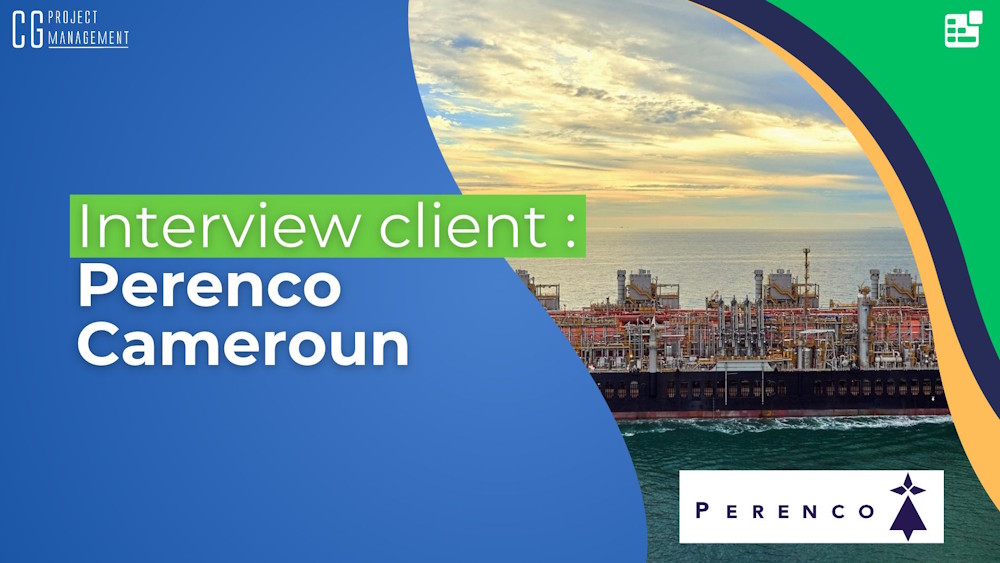
Perenco is a family-owned group specializing in oil and gas production, with operations in fourteen countries.
The Cameroonian subsidiary employs approximately 1,500 people, including offshore teams and support staff. It produces the equivalent of more than 80,000 barrels of oil and gas combined.
Within the oil industry, activities are generally divided between “subsurface” operation, which involve the subsurface, and “surface” operations, which encompass the infrastructure used to produce, process, transport, store, and sell the products.
Perenco Cameroon’s Surface Projects department is responsible for creating new infrastructure as well as major modernization and renovation work on existing facilities.

Bastien Voluer served as Director of Surface Projects at Perenco Cameroon from 2022 to 2026. He led a team of approximately 80 people, consisting of about 40 onshore employees and a workforce ranging from 40 to 80 people offshore, including subcontractors deployed at the job sites.
Since the projects are carried out almost exclusively offshore, their management involves numerous disciplines: process engineers, structural engineers, design engineers, project managers, construction teams, HSE specialists, supervisors, and lifting specialists. Cross-functional roles, such as logistics, procurement, and management control, are also involved in the projects.
“We manage a portfolio of about 25 active investment projects per year. These are primarily projects to build new infrastructure, but also include major modernization or renovation projects.
Depending on their size, these projects can last from six to eight months, and up to three or four years for the largest ones. They generally follow the same structure, with a conceptual design phase, validation, preliminary and detailed design studies, procurement and prefabrication, followed by on-site construction and final acceptance.
In practice, the various stages are not always so sequential, but these are the main steps we follow in our projects.
We also have a second component consisting of smaller projects, such as modifications or technical support for manufacturing certain equipment.”
“When I arrived in Cameroon four years ago, projects were mainly managed in Excel.
Each project manager had their own file, with its own charts, colors, formulas, and level of detail. Some worked with daily schedules, others with weekly ones, with varying levels of detail or a more macro view.
The information wasn’t always up to date. Whenever we needed to report a completion date or a progress level, it sometimes took two days of work to update the files and consolidate the data.
It was also very difficult to produce a consolidated workload plan. We could put something together on an ad hoc basis, but it wasn’t really based on data from each individual project.
As a project director and portfolio manager, this situation was quite complicated to manage. So I quickly looked into what solutions were being used at other subsidiaries and whether there were any recommendations from Perenco. But in the end, everyone operated fairly independently.
I then began looking for a solution and came across Gouti. About six months passed between the time I discovered the tool and the launch of the testing phase. After a few months of using it in real-world conditions, we migrated the entire portfolio to Gouti.
Since then, Gouti has become our single source for project planning.”
“I had already been keeping an eye on the various tools available on the market for some time. I also had a pretty clear idea of the type of solution I was looking for, the features I expected, and the hosting model.
We had one major constraint: Perenco’s IT environment isn’t always very flexible. So, to start with, I wanted a solution that could be deployed without having to involve the entire IT department.
Today, the IT teams are involved, but initially, I wanted to be able to move forward fairly quickly. I did, however, take the time to verify the aspects related to security and data hosting, and then we filled out the various required forms to reassure the teams on these issues.”
“Above all, I wanted a collaborative solution with a portfolio view and schedules simple enough for anyone to use.
Gouti also had the advantage of already being structured. We didn’t have to build our own processes from scratch within the tool. At the time, our project management process wasn’t yet fully formalized, and Gouti adapted well to our organization. For our part, we also adapted to the way the tool works.
This is both an advantage and a limitation: when you want to operate very differently from what’s built into the software, it’s not always possible. But the advantage is that we were able to roll out a functional solution in just a few weeks.”
“We first took advantage of the free trial period, then placed an order to roll out the solution more widely.
We tested Gouti in real-world conditions for a few months before migrating our entire portfolio. Adoption was fairly rapid, and we gradually increased the number of licenses. We now have just over thirty users.
We organized training at the start. It was important because some people need guidance to get comfortable with a new tool. But in practice, for the simplest tasks, a thirty-minute presentation is usually enough for users to become self-sufficient.
We didn’t encounter any real adoption challenges or particular resistance. The tool is simple and intuitive, so employees are generally happy to use it.
However, it still requires regular follow-up to remind teams to update their schedules, tasks, and time tracked. The goal is for everyone to open Gouti in the morning, check their to-do list and messages, then update the information throughout the day before closing the tool in the evening.
We haven’t yet reached that level of adoption across the board, but there are no major roadblocks to using it. Some people are simply more comfortable than others with advanced features or with figuring out how the tool works on their own.”
“Currently, I have five project managers who primarily use the scheduling feature, as well as certain other project management features.
The design office teams and process engineers make heavy use of task lists and timesheets. These are roles that work on multiple projects simultaneously, particularly when conducting studies or performing calculations. The HR module therefore allows them to track their activity and report the time spent on each project.
We’re also increasingly using the features related to actions, issues, and changes. This is in response to a request from our management, which wants better traceability of scope changes throughout a project’s lifecycle.
For my part, I mainly use Gouti in portfolio view to get an overview of the projects.
The tool is also widely used by managers in the engineering department and process teams to assess workload, assign tasks, and better organize employees’ work.”
“We rolled out the Ticketing module in a second phase.
It’s intended for other departments within the subsidiary when they need our teams to produce a plan, conduct a specific study, or address a technical issue.
This allows us to reduce some of the email correspondence and maintain a record of all requests in a single tool.
We can then directly link a request to tasks, assign the work to the relevant people, and allow employees to track what they need to do.
We’re quite satisfied with how this works, because everything remains centralized in Gouti, from the initial request to tracking the work completed.”
“The first advantage is having a centralized tool that’s accessible virtually anywhere and at any time.
Gouti is generally quite intuitive, especially for the simplest tasks. It often takes just about 30 minutes to show users how the tool works before they can use it on their own.
The tool is also fairly simple and well-defined. Sometimes, this simplicity can be a limitation when we’re missing a feature or want to operate differently than intended. But it has also allowed us to quickly establish a shared organizational structure.
We’ve moved from having separate Excel files for each project manager to a single source of truth for planning. This makes it easier to find information, gives us a consolidated view of the portfolio, and allows us to better track the teams’ workloads.
We’ve also started testing the export features and the API, even though we haven’t actually put them into production yet.”
“The support staff have always been available, and we’ve received answers to our various issues. I’m very satisfied with the support.
Overall, the relationship is going well. We’ve always been able to communicate with the teams whenever we needed to.”
“Simplicity, efficiency, and pragmatism.”
 Blog von Gouti